
Let’s solve the mystery by looking at it as a Crime-Scene.
Under normal conditions, life follows a strict cycle. When a creature dies, its bones eventually dissolve, returning to their mineral constituents to be reused by the soil biota. But the fossil record is an anomaly—it’s a massive graveyard of bones that didn’t rot. Why?
The Conflict: Religion vs. Religion
Evolution is often presented as objective science, but it relies on a ‘faith’ in slow, gradual processes that we never actually see happening. In reality, it functions as a secular religion, presupposing that millions of years can explain what the evidence suggests happened in an instant.
Take the Fossil Record for instance. Fossils don’t represent a slow transition, but a instantaneous burial. The presence of “soft tissue” in some dinosaur bones (like collagen) suggests they haven’t been sitting there for 65 million years, but were sealed in an anoxic (airless) tomb relatively recently. Rather than the sediment layers representing “ages,” they represent ecosystems being overwhelmed. As the floodwaters rose, seafloor creatures were buried first, followed by low-land animals, and finally those on higher ground. This explains the “order” of fossils without requiring vast amounts of time.
The Evidence: The “Flash-Seal” Requirement
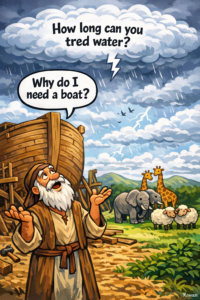
A fossil isn’t a product of time; it’s a product of catastrophe. For a bone to be preserved, it must be stripped of oxygen (anoxic) and buried deep in sediment before scavengers or bacteria can finish it. This requires a massive, high-energy event—like the Great Flood recorded in Genesis.
The Bible describes a 370-day event where the ‘fountains of the great deep’ broke open. This wasn’t just rain; it was a geological upheaval. This year-long process of rising and receding waters explains why we see layers of sediment across entire continents, trapping ecosystems in a chronological ‘snapshot’ rather than an evolutionary ‘timeline.’
The Fossil “Smoking Gun”
Both the evolutionist and the creationist look at the same fossils. One has faith in the power of time; the other has faith in the historical record of a global judgment. The question isn’t which one is ‘science,’ but which starting point best fits the evidence under our feet.
If these layers of earth represent millions of years, how do we explain polystrate¹.².³. fossils? Across the globe, we find fossilized tree trunks standing upright, piercing through multiple layers of strata. For a tree to be buried across ‘millions of years’ of sediment without rotting away at the top, the layers must have been deposited rapidly—all at once—during a massive geological upheaval like the 370-day Flood.
The Mathematical Leap of Faith
Evolution also requires a massive leap of mathematical faith. The chance of even a single functional protein forming by random mutations is roughly 1 in 10^175. To put that in perspective, there are only about 10^80 atoms in the entire universe. Proponents of evolution argue that ‘given enough time’ anything can happen, but no amount of time can overcome those odds. Relying on ‘time’ to solve a mathematical impossibility is a dogma, not a calculation.
Conclusion
When we stop trying to force the evidence into a timeline of millions of years, the ‘mystery’ of the fossil record disappears. The anoxic tombs, the soft tissue in dinosaur bones, and the polystrate trees all point to a singular conclusion: a world overwhelmed by water, buried in a year, and preserved as a warning. The evidence doesn’t require more time; it requires a better starting point.
¹- The term polystrate (from poly for “many” and strata for “layers”) more accurately describes the physical problem they present to an old-earth timeline.
²- The “Why” Behind the Name: The word isn’t in standard dictionaries because it challenges the uniformitarian (slow-and-gradual) view that dominates modern academia.
³- The Fossil “Smoking Gun”: a term to highlight that these fossils “pierce” through layers that are supposed to be millions of years apart. If a tree is standing vertically through 20 feet of rock, the bottom of the tree would have to “wait” for millions of years to be covered—which is a biological impossibility.